Posts

Kodi ani kunnem ( curry and clay pot)

Image
Imagine, if one day you sat to have food   and your mom said " Aiz Kodi na " Won't that be hard to believe ??  As a goan, fish curry rice is the prime items of our meals everyday. Goans just love their prawn n okra curry, specially when it's cooked in the earthen pot (kennel)                                                                    The  Earthen Pot It is believed that if the curry is simmered in the earthen pots, the curry gets a bit earthy flavour which makes the taste irresistible for goan taste buds .As compared to other utensils ,cooking in earthen pots is also considered to be healthy... Usage of such kind of pots keeps us connected to our roots , giving up these practices would be like forgetting all the valuable tradition .. ..           ...

RAJ BHAVAN,GOA(PALACIO DO CABO)

Image
The Raj Bhavan is a residential palace and fort situated in Dona Paula,Goa. It was known by the name "Palacio do Cabo" until it gained official status as the residence of the govenor of Goa. It is said that the palace was built between the 16th and 17th century by the Portuguese. Since the Portuguese belived in the motto "God, Glory and Gold" they built a church inside the palace which is dedicated to Our Lady Of The Cape and the feast of which is celebrated annually on 15th August. The church was looked after by the priests of different orders (Jesuits, Dominicans ,Franciscan) who also had a convent(Franciscan) attached to the  church. Since the fort was a safe heaven, it was later controlled by the priests without any military help and later on it became a temporary guest house for the archbishop, who was in most cases the governor. But in the mid 18th century the Jesuit priests who looked after the whole fort were forced to move out of the palace...

GOAN FISHING.

Image
GOAN FISHERS.. fishing is art and profession. Goa is very rich in fishing. Fishing being one of most important occupations of goan people.

THE GOOD OLD PORTUGUESE MANSIONS

Image
  One legacy of the long period of Portuguese colonization which is still quite in evidence and in everyday use is the magnificent architecture of the traditional mansions of the Goan gentry. Goa can perhaps claim to be the only place on the subcontinent where houses dating back to the 1700s are still in pristine condition and still inhabited by generations of the original owners.    These mansions were built in an era which saw the Portuguese raking in a handsome profit from their trading colonies in Africa and South America. Interestingly, the owners were not usually Portuguese noblemen, but wealthy Goan merchants and high-ranking officials who were granted land by the Portuguese. The materials and techniques for the construction of such houses was usually local while the furnishings and decorations came from all around the world. The walls and pillars were built of red laterite stone and local wood while the roof was overlai with terracotta roof tiles from Ma...

BRASS MUSIC.................A LOST TRADITION!

Image
  “Music is the harmony of the heart. Brass music became a part of the Goan culture though it was brought by the Portuguese,”Brass bands hold a beloved place in the Goan heart – for Catholic funerals, order for village feasts, for carnivals of every kind The fact that players in Goa can at best hope to earn about Rs 600 per performance only partially explains why the glitter of brass instruments has failed to draw young musicians into the orchestra. Tony Fernandes, who plays the trombone for the Goa police band, explains simply that brass is not “in.” “That’s because youngsters think it’s old-fashioned to be blowing a trumpet, saxophone or a clarinet. For them, it’s more mod, and hence attractive to strum a sleek electronic guitar or play the keyboards,”         Jose Cotta, 44, isn’t nearly as optimistic. A musician based in the village of Santa Cruz, he blames modern music gadgetry like the synthesiser for strangulating brass bands....

BASILICA OF BOM JESUS

Image
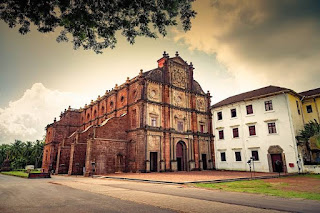
The Basilica of Bom Jesus or Borea Jezuchi Bajilika (Basílica do Bom Jesus) is located in Goa,India and is a UNESCO world Heritage Site. The Basilica holds the mortal remains of St. Francis Xavier. The church is located in Old Goa which was the capital of Goa in the early days of Portuguese rules. Bom Jesus' is the name used for the Ecce homo  in the countries of Portuguese colonization. The Jesuit church is India’s first minor Basilica, and is considered to be one of the best examples of baroque architecture in India. This church belongs to our goicho saib, St. Francis Xavier. On 3rd December people from all over the world come to experience the spiritual bonding with the saint on feast day. This church is also an amazing part of goan tourism.

THE GOAN BAKER (PODER)

Image
Early in the morning at around 6o'clock I wake up by this sound Ponku Ponku.. .It is the sound of no bell nor vehicle,it is the sound of the honking of the horn made by the neighbourhood baker (Poder) announcing his arrival in the village on his bicycle. The poder delivers variety of freshly baked, hot breads like the paõ (soft bread) undo (crispy bread) poie (whole wheat bread) and not to forget the kakon(bangle shaped crispy bread)at our doorsteps 2 times a day (morning and evening). All this has become like a part of my life,without listening  the honking of the poders horn I don't get up in the morning. Bread making is one of the traditional business of Goa. It is an art, legacy which was granted by the Portuguese to the Goan people. Since then it is been carried on for centuries. Bread making is not just a business it has become an identity of Goans. My brother who is a seafarer told me that people abroad call him and every other Goan "paõ" because we...